

Coban and ACE bandages both stretch, both come in rolls, and both get called "wraps." But they hold on in different ways, and that changes how you use them. Here's how to tell which one fits the job in front of you.
The quick answer
- Coban is a light, stretchy wrap that sticks to itself but not to skin or hair. No clips, no tape. It's usually used once and thrown away.
- Coban LF is the latex-free version. It also tears by hand, so you don't need scissors.
- An ACE-style elastic bandage is a woven stretch fabric. It doesn't stick to anything, so it closes with clips or a hook-and-loop strip. You can wash it and use it again.
Pick Coban when you want something quick and low-profile that won't slide, like holding a dressing on a finger or forearm. Pick an elastic bandage when you'll wrap and unwrap the same spot many times, or want to hold an ice pack or splint in place.
Coban vs Coban LF vs ACE-style elastic bandage
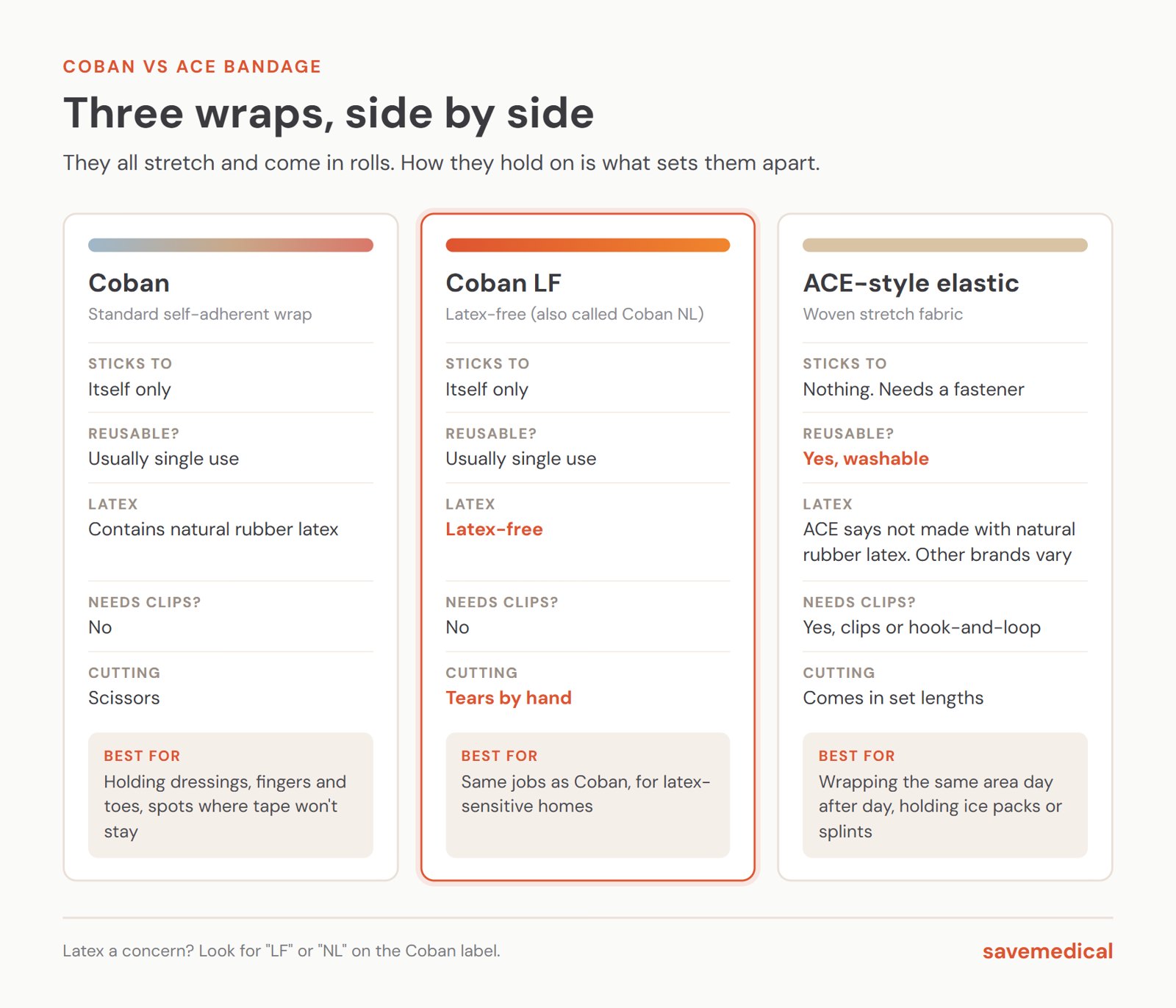
| Coban (standard) | Coban LF (latex-free) | ACE-style elastic bandage | |
|---|---|---|---|
| Sticks to | Itself only | Itself only | Nothing. Needs a fastener |
| Reusable? | Usually single use | Usually single use | Yes, washable |
| Latex | Contains natural rubber latex | Latex-free | ACE says theirs aren't made with natural rubber latex. Other brands vary |
| Needs clips? | No | No | Yes, clips or hook-and-loop |
| Cutting | Scissors | Tears by hand | Comes in set lengths |
| Best for | Holding dressings, fingers and toes, spots where tape won't stay | Same jobs, for latex-sensitive homes | Wrapping the same area day after day, holding ice packs or splints |
3M Coban: the self-adherent wrap
Coban is a thin, porous wrap that grips only to itself. Lay it over a pad, press the last layer down, and it stays put. Nothing sticky touches the skin, which is why so many caregivers use it over non-stick pads like Telfa.
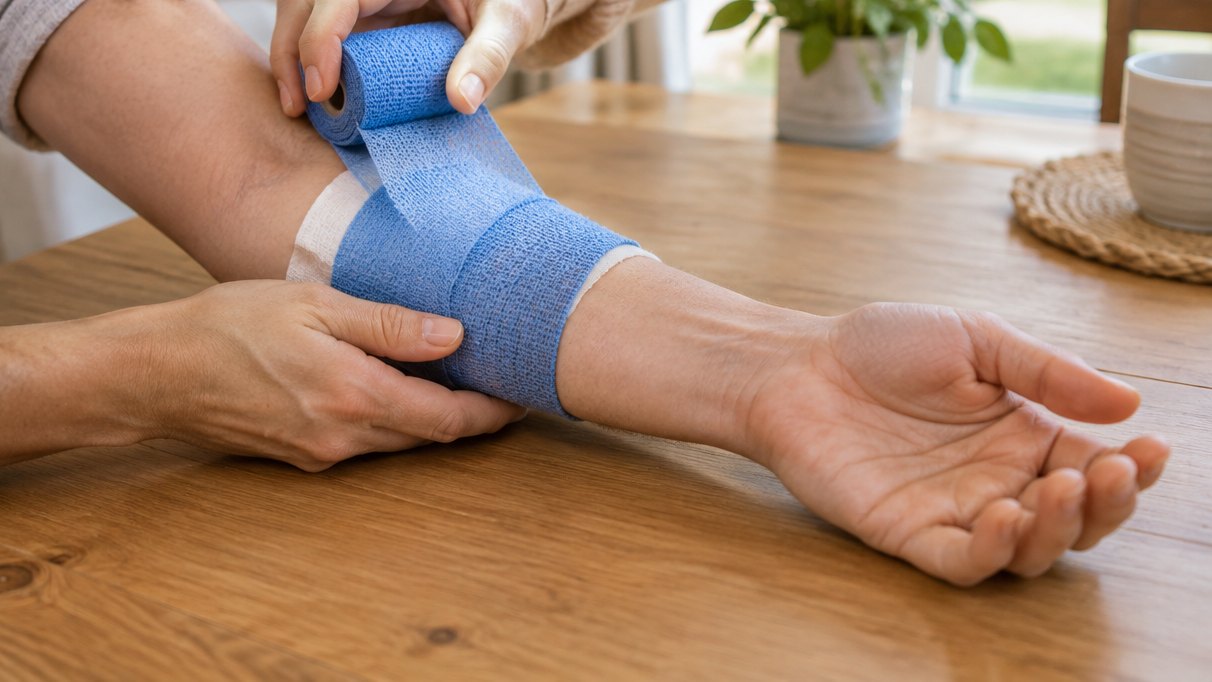
According to Solventum, the company that now makes Coban, standard Coban:
- Is made with natural rubber latex
- Comes non-sterile
- Needs scissors to cut
- Comes in rolls 5 yards long
- Comes in 1, 2, 3, 4 and 6 inch widths, in tan, blue, red and white
We carry 3M Coban in 1, 2, 4 and 6 inch widths, in tan or blue. You can buy a single roll or a box or case.
Want a lower-cost option? Our McKesson cohesive bandage works the same way. It comes in 1, 2, 3 and 4 inch widths, in tan or a mix of colors that kids tend to like. It also contains latex.
Coban LF: the latex-free choice
If anyone in your home has a latex allergy, skip standard Coban. Coban LF is made without natural rubber latex. It also tears cleanly by hand, which is handy when you're holding a dressing in place with one hand.
You may see this same product called "Coban NL" on Solventum's site. Both names mean latex-free. Look for "LF" or "NL" on the label before you buy.
ACE-style elastic bandages: the reusable wrap
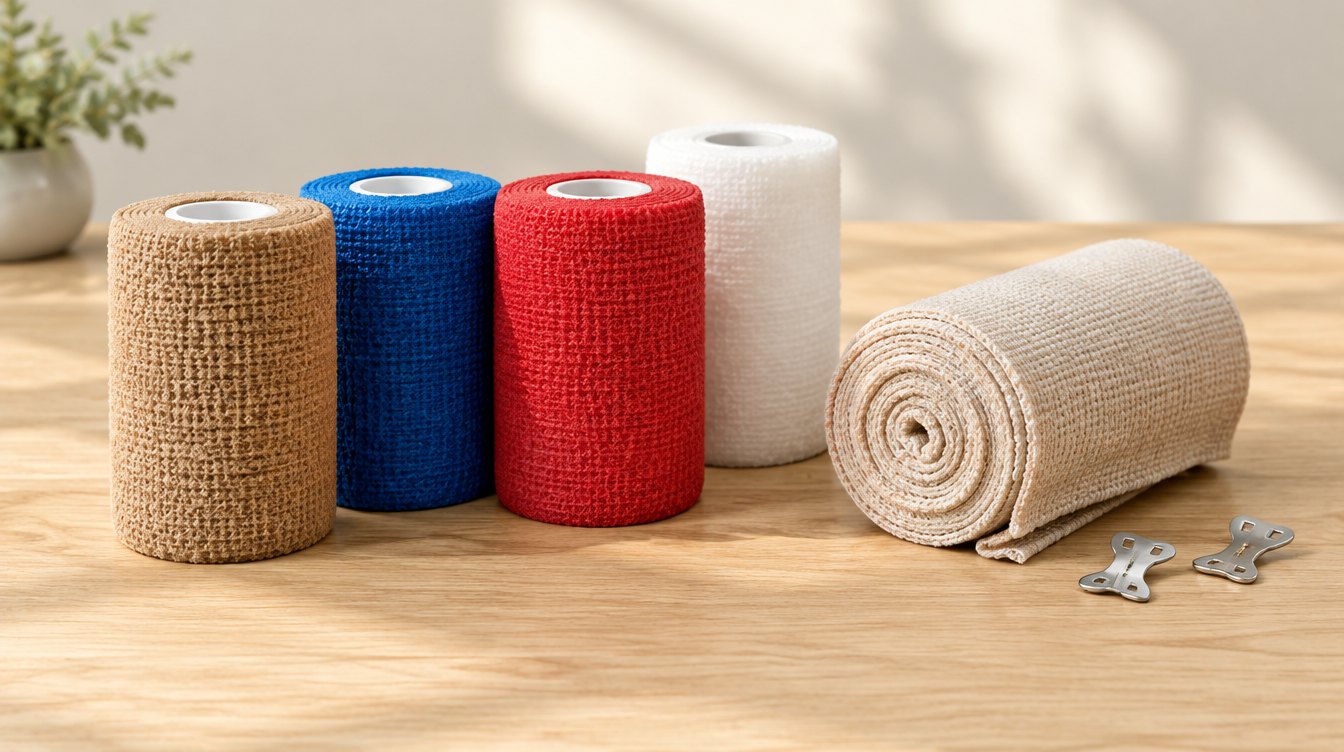
An elastic bandage is the classic tan roll most people picture. It's a soft stretch fabric that doesn't stick to itself, so you finish it with a fastener.
Good to know
ACE clips can slip. EMTs suggest tucking the loose end under the last layer instead of trusting the clip alone.
- Clip closure. Small metal clips grab the fabric at the end. The 3M ACE elastic bandage with clips comes in a box of 10.
- Hook-and-loop closure. A strip at the end presses on like Velcro. No clips to lose. Our McKesson hook-and-loop elastic bandage is latex-free and comes in a box of 10 or a case of 50.
The big plus is reuse. The ACE brand FAQ says to rinse it by hand in lukewarm water, skip scrubbing, lay it flat to dry, then roll it back up smoothly. Don't iron it.
The trade-off: an elastic bandage can slide or bunch, especially on a moving joint. It also loses some stretch after many washes. When it feels loose even when snug, it's time for a new one.
How to wrap without making it too tight
Both wraps can get tighter than you expect. Coban is the bigger risk, because it keeps gently pulling in after you put it on.
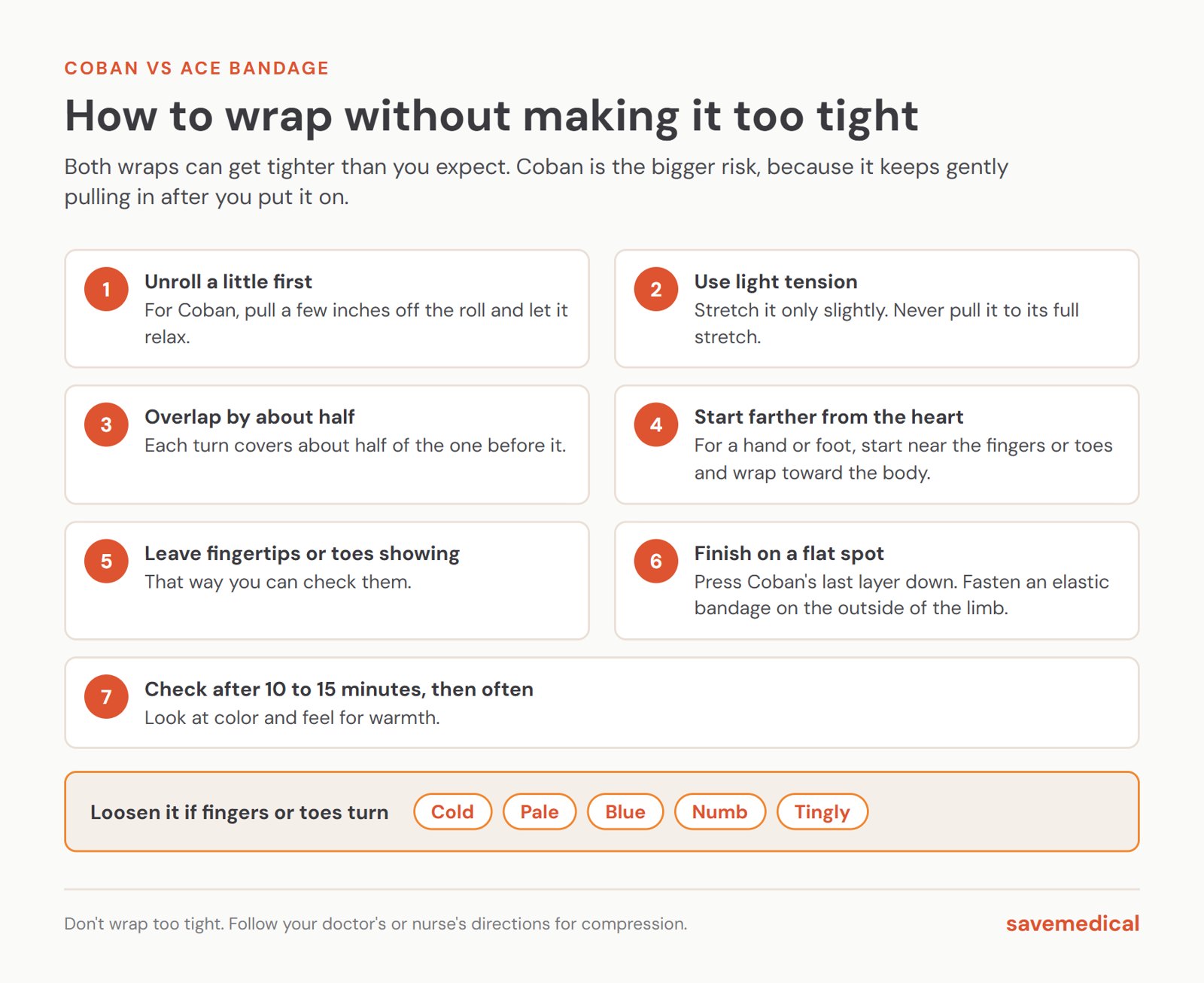
- Unroll a little first. For Coban, pull a few inches off the roll and let it relax. Don't wrap straight off a tight roll.
- Use light tension. Stretch it only slightly as you lay it down. Never pull it to its full stretch.
- Overlap by about half. Each turn should cover about half of the one before it.
- Start farther from the heart and work up. For a hand or foot, start near the fingers or toes and wrap toward the body.
- Leave fingertips or toes showing. That way you can check them.
- Finish on a flat spot. Press Coban's last layer down. For an elastic bandage, clip or fasten it on the outside of the limb, not under it.
- Check after 10 to 15 minutes, then often. Look at color and feel for warmth.
Don't wrap too tight. If fingers or toes turn cold, pale, blue, numb or tingly, loosen it. Follow your doctor's or nurse's directions for compression.
What people say
We read nurse, EMT and pet owner threads on Reddit, plus shopper reviews. Here's what came up most.
Nurse tip
Don't pre-stretch Coban. Lay it on loose, then check fingers and toes.
- "Don't pre-stretch Coban." This is the top tip from nurses. It's easy to wrap too snugly, so lay it on loose and check fingers and toes (r/nursing).
- Take it off and look. Nurses who use Coban to cover IV sites say to keep it loose and remove it often to check the skin underneath (r/nursing).
- Kinder to fragile skin than tape. Caregivers like that nothing sticky touches thin skin. One tip: keep a pad between any open area and the wrap (r/nursing).
- ACE clips can slip. EMTs suggest tucking the loose end under the last layer, or tying it off, instead of trusting the clip alone (r/EMS).
- Same wrap, different name for pets. "Vet wrap" is the same kind of self-adherent material. Dog owners warn it's very easy to wrap a paw too tight, and suggest comparing warmth with the other paw (r/dogs). Ask your vet before wrapping a pet.
- Finding the end is fiddly. Shoppers say Coban's loose end can be hard to spot on the roll. Some reviewers also mention rolls sticking together when stored somewhere hot (shopper review). Store rolls in a cool, dry spot.
Which width do I need?
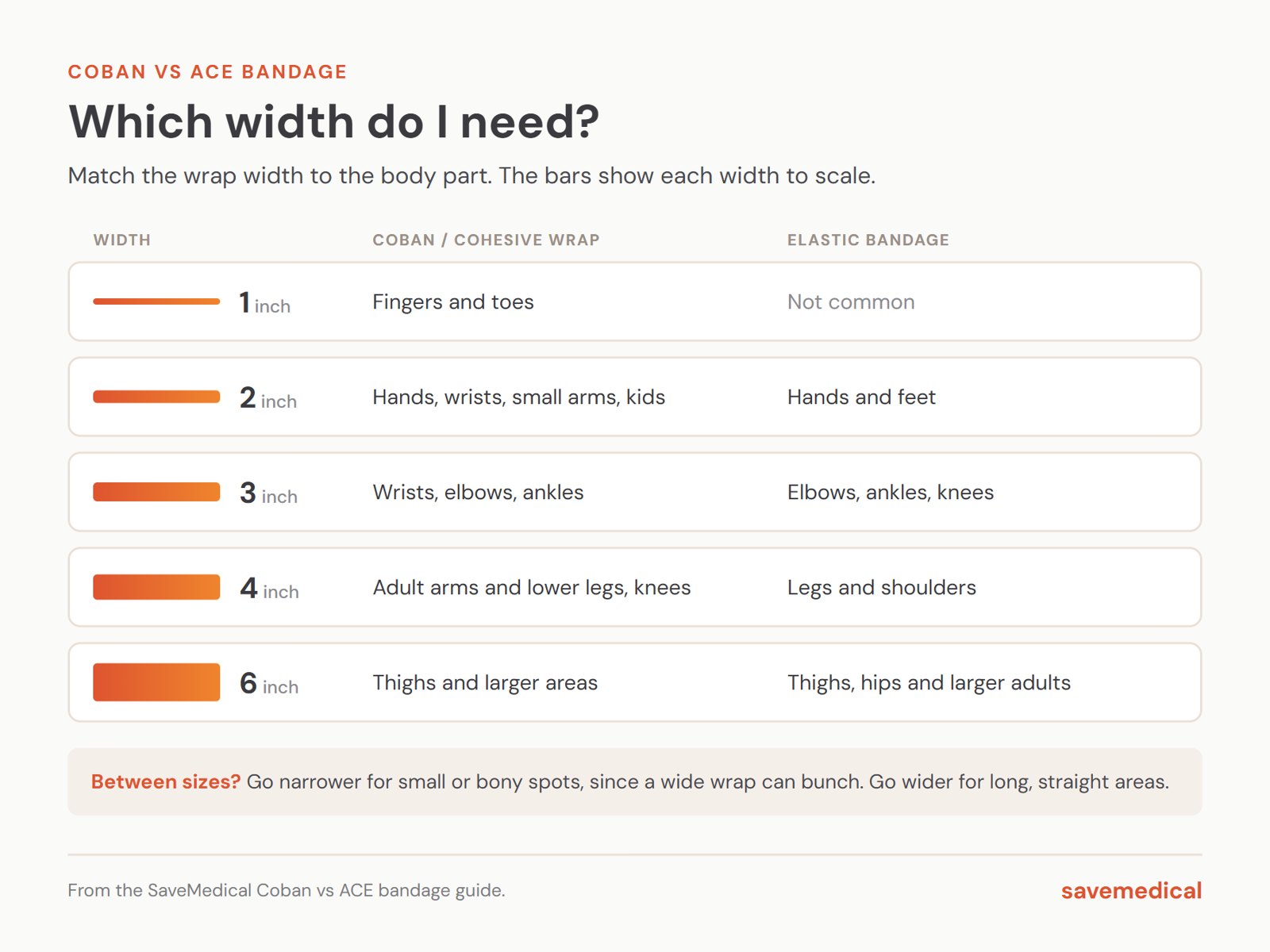
| Width | Coban / cohesive wrap | Elastic bandage |
|---|---|---|
| 1 inch | Fingers and toes | Not common |
| 2 inch | Hands, wrists, small arms, kids | Hands and feet |
| 3 inch | Wrists, elbows, ankles | Elbows, ankles, knees |
| 4 inch | Adult arms and lower legs, knees | Legs and shoulders |
| 6 inch | Thighs and larger areas | Thighs, hips and larger adults |
When you're between sizes, go narrower for small or bony spots, since a wide wrap can bunch. Go wider for long, straight areas.
You'll find more wraps and dressings in our First Aid & Wound Care collection. Free shipping on orders $75+. Applied automatically at checkout.
Frequently asked questions
Is Coban the same as an ACE bandage? No. Coban sticks to itself and needs no clips. An ACE bandage is woven elastic that needs clips or a hook-and-loop strip. ACE bandages are washable and reusable. Coban usually isn't.
Can you reuse Coban? It's made to be used once. After you unwrap it, it loses some of its grip and stretch. Plan on a fresh piece each time.
Does Coban contain latex? Standard 3M Coban is made with natural rubber latex. Coban LF (also called Coban NL) is latex-free. Check the label if latex is a concern.
Is a cohesive bandage the same as self-adherent wrap? Yes. "Cohesive bandage," "self-adherent wrap" and "vet wrap" all describe a wrap that sticks to itself and not to skin. Coban is 3M's brand name for it.
Can I tear Coban by hand? Coban LF is made to tear by hand. Standard Coban needs scissors, according to Solventum.
How do I wash an ACE bandage? Hand rinse in lukewarm water, don't scrub, lay it flat to dry, then roll it back up. Don't iron it.
Questions about which wrap fits your needs? Call us at 866-420-6997. We're happy to help.
