

If you're buying incontinence supplies for a mom, dad, or spouse, you've probably noticed there's no single "best" product. What works depends on how well the person moves, what happens overnight, and who's doing the changes. This guide walks through each product type in plain terms, so you can match the product to the person and stop guessing.
The quick answer
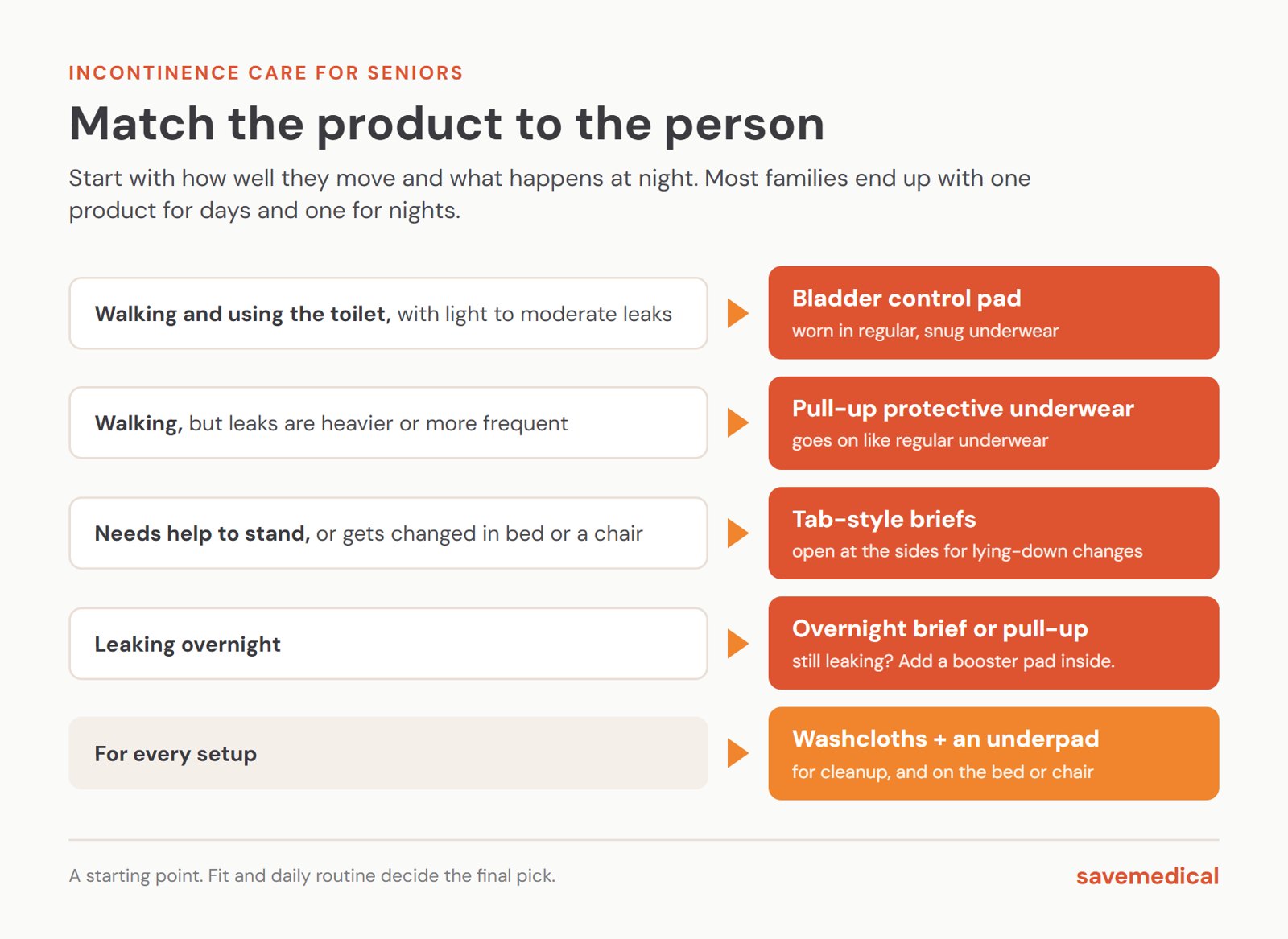
- Still walking and using the toilet, with light to moderate leaks: a bladder control pad worn in regular, snug underwear.
- Walking, but leaks are heavier or more frequent: pull-up protective underwear.
- Needs help to stand, or gets changed in bed or a chair: tab-style briefs. They open at the sides, so you can change them with the person lying down.
- Leaking overnight: an overnight-rated brief or pull-up first. If that still isn't enough, add a booster pad inside it.
- For every setup: disposable washcloths for cleanup and an underpad on the bed or chair.
Most families end up with two products: one for daytime and one for nights. That's normal.
Match the product to the person
| Situation | Product type | Absorbency | Why it works |
|---|---|---|---|
| Walks on their own, small drips with a cough or on the way to the bathroom | Bladder control pad in regular underwear | Light to moderate | Slim, private, and they can change it themselves |
| Walks on their own, heavier daytime leaks | Pull-up protective underwear | Moderate to heavy | Goes on like regular underwear, more coverage than a pad |
| Uses a cane or walker and can stand to change | Pull-up, or a long pad if leaks are lighter | Heavy | Stays in place when sitting for long stretches |
| Needs help standing or uses a wheelchair full time | Tab-style brief | Heavy to maximum | Changes happen seated or lying down, no lifting legs |
| Mostly in bed | Tab-style brief plus an underpad | Maximum or overnight | Change by rolling side to side; the underpad catches what gets past |
| Leaks through overnight products | Overnight brief or pull-up plus a booster pad | Overnight plus booster | Adds capacity without moving to a bulkier size |
| Takes off pull-ups (common with memory loss) | Tab-style brief, with pants over it | Heavy | Tabs are harder to slip off than a pull-up |
Bladder control pads and guards
Pads stick inside regular underwear. They're the most private option and the easiest to accept for someone who doesn't want to "wear something." Men's guards are cup-shaped and sit in the front of briefs-style underwear.
Pads work best when the person still uses the toilet and just needs backup. Length matters more than many people expect. A long pad covers further toward the back, which helps when your parent spends a lot of time sitting in a recliner. One of our reviewers said the long size was "perfect" for that reason.
Two tips that fix a lot of pad leaks:
- Check the underwear, not just the pad. Stretched-out underwear lets a pad sag and gap. Newer, snug cotton underwear holds it flat.
- Smooth the pad after pulling up. The back end can fold over when underwear goes up. A quick check with the hand keeps it flat.
If a maximum pad is full at every change, it's time to look at pull-ups.
Shop incontinence pads and liners
Pull-up protective underwear
Pull-ups look and feel the most like regular underwear. The absorbent core is built in, so there's nothing to stick or shift. They're a good fit for someone who can stand, or at least lift their hips, and who wants to manage the bathroom on their own.
Pull-ups have two weak spots:
- Changing them means taking off pants and shoes, or tearing the side seams. That's fine at home, harder on outings.
- They're easy to take off. Caregivers caring for a parent with memory loss often mention finding pull-ups removed in bed. Snug pants or shorts over the pull-up can help. If it keeps happening, tab-style briefs are usually the better choice.
Daytime and overnight pull-ups are different products. Overnight versions hold more and often rise higher in the back. If your parent leaks only at night, switch the night product before changing anything else.
Tab-style briefs
Tab-style briefs (often called adult diapers) open flat and fasten with tabs at the hips. You can put one on while the person is lying on their side, then roll them back and fasten. No standing, no pulling over feet.
Caregiver tip
Many caregivers say they held on to pull-ups too long. Once changes happen in bed, tab briefs make the job faster and easier on your back.
Choose briefs when:
- Your parent needs help to stand or transfer
- Changes happen in bed, a wheelchair, or a recliner
- There are bowel leaks as well as bladder leaks
- Pull-ups are leaking even in the right size
Getting a good seal takes a little practice:
- Pull the leg gathers out so they sit in the crease of the leg, not tucked under.
- Fasten the bottom tabs angled slightly upward, toward the belly button. Many caregivers say this snugs the fit around the legs.
- Then fasten the top tabs straight across. Snug, with room for two fingers at the waist.
Not sure about the technique? Ask a home health nurse to show you once. It gets quick with practice.
Shop adult briefs and protective underwear
Booster pads (for heavier leaks and nights)
A booster pad, sometimes called a doubler, is a thin insert that goes inside a disposable brief or pull-up. It soaks up the first rush, then lets extra fluid pass through its back into the brief underneath. You get more capacity without a bulkier product.
Caregiver tip
Night leaks need their own plan. Several caregivers said an overnight brief, a booster, and an underpad on the bed finally ended the nightly sheet changes.
A few things to know before you buy:
- Boosters are for use inside disposable briefs or pull-ups, not regular underwear. Most have no waterproof backing, on purpose.
- Size matches the brief. A smaller booster such as the Tranquility TopLiner Booster Pad, 4 x 14 inch suits smaller briefs. The TopLiner Super, 4.25 x 15 inch adds more for larger sizes and overnight.
- A booster won't fix the wrong size. If a brief leaks while it's still mostly dry, the fit is the problem. Fix that first.
- Put the booster in the center of the brief before it goes on, so it doesn't bunch at the leg openings.
Some reviewers say boosters cut down on nighttime bed changes. Others note they can shift if the brief is loose. Try one pack before buying a case.
Underpads for the bed and chair
An underpad is a flat, absorbent pad that goes on top of the sheet, a recliner, or a wheelchair seat. Even with the right brief, things get past now and then. An underpad means changing a pad instead of the whole bed at 3 a.m.
We cover sizes, disposable vs. reusable, and low air loss pads in our full guide, How to Choose Bed Underpads. The short version: most adult beds need a 30 x 36 inch pad or larger, with heavy absorbency for nights.
Wipes and cleanup
Cleanup supplies get used more than people expect. Keep them within arm's reach of wherever changes happen.

- Disposable washcloths. Larger and thicker than baby wipes. Fragrance-free is a good default if your parent's skin is sensitive. McKesson Fragrance Free Washcloths come in 96-count packs.
- No-rinse cleanser. A spray or squeeze bottle that cleans without a basin and towel, handy for bed changes. Try McKesson Rinse-Free Perineal Wash.
- Barrier cream. Many caregivers use a zinc oxide or dimethicone cream at changes. Ask your parent's doctor or nurse which one fits their skin.
- Disposable gloves and small bags for used products.
A small caddy by the bed or chair with all of this saves a lot of trips across the room.
How to get the size right
Size is the most common reason for leaks. Too big, and urine runs out the gaps at the legs before the core can soak it up. Too small, and the product fills fast and pinches.
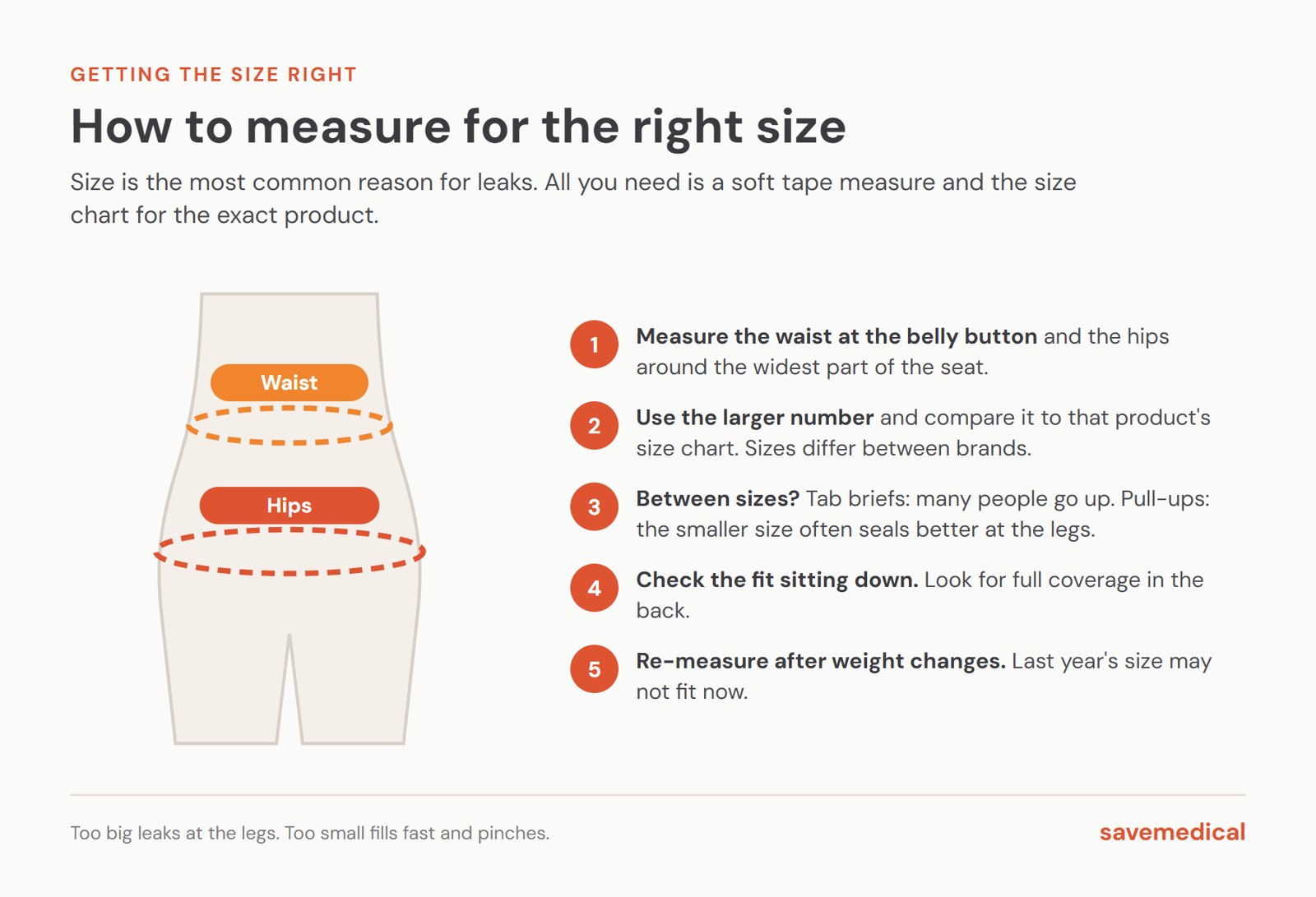
- Use a soft tape measure. Measure the waist at the belly button, and the hips around the widest part of the seat.
- Use the larger number and compare it to the size chart for the exact product. Sizes aren't the same between brands, and some brands use numbers (Size 1, 2, 3) instead of S, M, L.
- Between sizes? With tab briefs, the tabs give you some room to adjust, so many people go up. With pull-ups, the smaller size often seals better at the legs, as long as it isn't tight.
- Check the fit sitting down. For someone who sits most of the day, look for full coverage in the back. One reviewer told us the S/M pull-up was a bit short in the seat, which is a sign to try the next size or a higher-rise style.
- Re-measure after weight changes. A product that fit last year may not fit now.
How many do you need per month?
Every person is different, so track changes for 3 days, then multiply. Here's a starting point for one person:
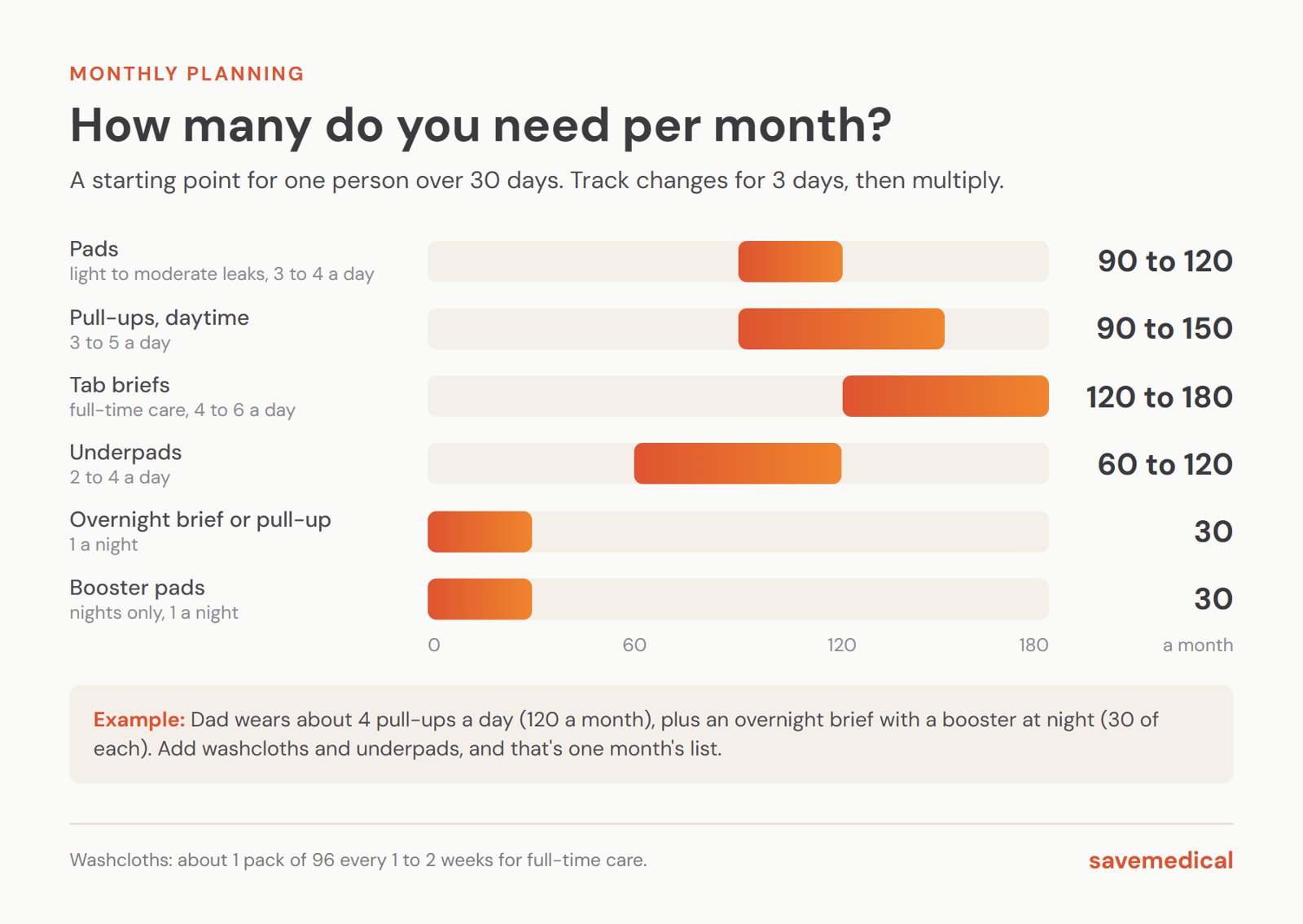
| Routine | Per day | Per month (30 days) |
|---|---|---|
| Pads, light to moderate leaks | 3 to 4 | 90 to 120 |
| Pull-ups, daytime | 3 to 5 | 90 to 150 |
| Tab briefs, full-time care | 4 to 6 | 120 to 180 |
| Overnight brief or pull-up | 1 | 30 |
| Booster pads, nights only | 1 | 30 |
| Disposable washcloths | 2 to 3 per change | About 1 pack of 96 every 1 to 2 weeks for full-time care |
| Underpads | 2 to 4 | 60 to 120 |
Example: your dad wears pull-ups during the day and an overnight brief with a booster at night. That's about 4 pull-ups a day (120 a month), 30 overnight briefs, and 30 boosters. Add washcloths and underpads, and you have one month's list.
A common budgeting mistake is buying a full case before you know the size works. Start with a bag, then move to a case once you're sure. If you'd rather not keep track of reorders, Autoship, our automatic delivery program, is available on eligible items. You can skip, change, or cancel anytime.
What caregivers say
We read through caregiver discussions on Reddit and our own customer reviews. A few themes came up again and again:
- "Move to tab briefs sooner." Many caregivers said they held on to pull-ups too long. Once changes happened in bed, tab briefs made the job faster and easier on their backs.
- Night leaks need their own plan. Several said an overnight brief, a booster, and an underpad on the bed finally ended the nightly sheet changes.
- Removing products is common with memory loss. Caregivers had better luck with tab briefs, snug pants over the product, and checking on a regular schedule.
- Fit beats brand. The same labeled size can fit very differently between brands. Several people solved leaks by switching brands, not absorbency.
- Words matter. Calling them "protective underwear" or "backup for nights" instead of "diapers" made a real difference for some parents. Letting a parent pick between two options helped too.
- Consistency matters to long-time users. Some of our own customers noticed when a product they'd used for years changed. If something stops working after a reorder, check the package and call us. We'll help you find a close match.
Our picks
These are starting points by situation. All are on SaveMedical.com.
| Situation | Our pick |
|---|---|
| Mobile, light to moderate leaks, sits a lot | Nexwear Maximum Pads, Long |
| Mobile, heavier pad needs | Nexwear Ultimate Pads |
| Daytime pull-up | Tranquility Premium DayTime Disposable Absorbent Underwear |
| Overnight pull-up | Tranquility Premium OverNight Disposable Absorbent Underwear |
| Limited mobility, overnight tab brief | Prevail Air Overnight Briefs |
| Limited mobility, daytime tab brief | Tranquility SmartCore Maximum Protection Brief |
| Extra capacity inside a brief or pull-up | TopLiner Booster, 4 x 14 inch or TopLiner Super, 4.25 x 15 inch |
| Cleanup | McKesson Fragrance Free Washcloths and McKesson Rinse-Free Perineal Wash |
| Bed and chair | See How to Choose Bed Underpads |
Free shipping on orders $75+. Applied automatically at checkout. Questions about sizes or which product fits? Call us at 866-420-6997.
Frequently asked questions
What's the best incontinence product for an elderly person? It depends on mobility. Pads suit people who walk and use the toilet. Pull-ups suit people who can stand to change. Tab-style briefs suit anyone who needs help standing or gets changed in bed. Most people use one product for days and another for nights.
Are pull-ups or tab briefs better for someone with limited mobility? Tab briefs, in most cases. They open at the sides, so you can change them while the person is lying down or seated. Pull-ups need the person to stand or lift their hips.
How do I stop overnight leaks? Start with fit, since a loose product leaks early. Then move to an overnight-rated brief or pull-up. If it still leaks, add a booster pad inside it and put an underpad on the bed.
Can I put a booster pad in regular underwear? No. Boosters are made to pass fluid through to a disposable brief or pull-up underneath. In regular underwear, that fluid has nowhere to go. Use a bladder control pad instead.
How do I get my parent to wear incontinence products? Keep it low-key. Use the words they're comfortable with, like "protective underwear." Offer a choice between two products, start with the most discreet one that works, and make it part of the bedtime routine.
When should we talk to a doctor? Ask the doctor or nurse about any new or worsening leaks, and about skin care. It's worth a visit before you simply move to heavier products.

